
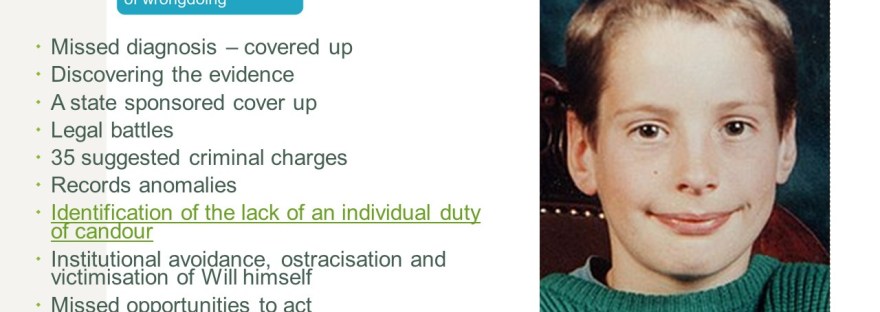
Robbie Powell was admitted to hospital in 1989 with weight loss and vomiting. During this admission Addison’s disease was suspected and his GPs were put on notice to refer him back to hospital if this recurred. His family were not told of this suspected diagnosis, and the existence a letter to his GPs conforming this, which his father saw, and which was independently witnessed was subsequently denied.
Robbie’s was re-admitted to hospital in 1990 and died the same day of Addison’s disease.
In the final 15 days before Robbie died, he was seen by five different doctors, seven times, four of whom were found by a medical expert to have been grossly negligent:
Dr Paul Boladz saw Robbie two days before his death. He refused to visit Robbie at home and diagnosed glandular fever when he examined him at the local hospital. He prescribed Amoxicillin (which should not be given to suspected glandular fever patients) and booked blood tests for Robbie for two days later. Dr Boladz was deemed grossly negligent.
Dr Keith Hughes saw Robbie the day before he died. He failed to spot the symptoms of Addison’s disease, postponed a vital blood test, was unable to carry out a crucial blood sugar test, due to out-of-date equipment, and initially refused Robbie a hospital admission. Dr Hughes was deemed grossly negligent.
But it was two doctors in particular whose actions were criticised most heavily by the CPS, regarding a possible cover-up: Dr Nicola Flower and Dr Michael Williams.
Ongoing 35-year struggle
After failing to make any headway with the complaint process and legal action, Robbie’s father Will Powell made a formal complaint against the Chief Constable of Dyfed-Powys Police in late 1999.
In the investigations carried out by Dyfed-Powys Police were found to be ‘institutionally incompetent’ by Avon & Somerset Constabulary in 2003.
Will Powell’s complaint against the Chief Constable resulted in Dyfed-Powys Police appointing an outside police force to review Robbie’s case. Detective Chief Inspector Robert Poole [DCI Poole] from West Midlands Police was appointed in early 2000.
DCI Poole’s report, entitled Operation Radiance, which was based on the documents provided to Dyfed Powys Police in March 1994, by WP and his solicitor, was submitted to CPS York in March 2002. This report put forward 35 suggested criminal charges against five doctors and their medical secretary. The suggested changes were:
- Gross negligence manslaughter.
- Forgery.
- Attempting to pervert the course of justice.
- Conspiracy to pervert the course of justice.
Missing compuiter records
Recently I have been looking at Robbie’s computerised records. Access to these was initially refused and lies were told about whether they existed or not. (An examination of the computerised records was not included in Operation Radiance).
Eventually, seventeen months after the original request, some of Robbie’s computer record were produced. These are incomplete and appear to have been tampered with as Robbie’s death is not recorded and he has no episodes of care recorded on the information which was eventually produced. In addition the printout purported to be is highly suspect as it lists Robbie’s age as ’17’. Robbie died when he was 10.
Identification of a lack of an individual duty of candour for health professionals:
Until the case of Robbie Powell, the existence, or otherwise, of a legal duty of candour for healthcare professionals had not been raised or tested in the UK civil courts.
Had it not been for the Powells refusing to accept a six figure out of court settlement in 1996 and pursuing Robbie’s case through the UK and European courts, the absence of a legal duty of candour is unlikely to have been publicly exposed by any other medical negligence case. At the time the Powells had remortgaged their home and were on benefits.
In response to the 1997 Court of Appeal ruling in Robbie’s case, Dr Brian Goss of the BMA’s General Medical Services Committee, stated in GP magazine, on 11th July 1997: “GPs could now put a gloss on the cause of death without fear of litigation”.
The law, as it stood in 2000, was clearly set out by the European Court of Human Rights when it found Robbie’s case inadmissible and ruled there had been no breaches of the child’s human rights.
The ECHR stated “whilst it is arguable that doctors had a duty not to falsify medical records under the common law (Sir Donaldson Mr’s ‘duty of candour’), before Powell V Boladz there was no binding decision of the courts as to the existence of such a duty.
“As the law stands now in 2023, doctors have no duty to give parents of a child who died as a result of their negligence a truthful account of the circumstances of the death, nor even to refrain from deliberately falsifying records.”
As a consequence of refusing the initial offer to settle the case, in 1996, the Powells ended up with no compensation and an order for costs against them.
Update 12.01.2023
Both the English and Welsh Health Ombudsmen are calling for a Public Inquiry into the death of Robbie Powell.
The case remains open with the Crown Prosecution Service who now have an additional report on the anomalies in Robbie’s computerised records.
I have developed and delivered teaching sessions on ethics, the law and accountability using Robbie’s case. These sessions have identified lost learning as result of the ongoing cover up. For more information on this email carerightnow@gmail.com


 Steve Turner's blog site