
A summary & Frequently Asked Questions
🔵Putting the Public Interest first 🔵
🔵 Making whistleblowing history 🔵
The Protection for Whistleblowing Bill [HL]1 which passed its second reading in December 2022, proposes the repeal of the current Public Interest Disclosure Act2 [PIDA], replacing it with an Office of the Whistleblower [OWB]. This would prevent concerns of genuine healthcare whistleblowers becoming buried under an employment issue, and their original issues being sidelined. There are many examples of this happening, the most recent being the treatment of whistleblowers who raised concerns over a nurse who was later found guilty of murdering seven babies and attempting to murder another six3. Because the people who first raised concerns were initially bullied and intimidated into silence, it was a year before the initial concerns were acted upon, during which time the nurse went on to murder a further 5 babies and attempt to murder a further five4.
Why do we need a change in the law?
Current UK whistleblowing law, the Public Interest Disclosure Act2 [PIDA], is expensive, limited in scope and beyond the reach of most whistleblowers. It is also overly complex, with cases currently waiting for over 2 years to be heard. Employers game the system to run whistleblowers out of funds.
PIDA does not protect patients and is not accessible to members of the public who blow the whistle. Currently there is no statutory provision to investigate or address the wrongdoing highlighted by whistleblowers, and whistleblowers have been denied any protection because they are not workers.
Media reports on whistleblowing in healthcare tend to focus our attention on senior people and on Employment Tribunals. Behind every high-profile whistleblower in health and social care there are many more people who are suffering detriment for speaking out and have not been able, or not wanted, to take legal action. This includes people at all levels in the organisations and from all professions. This is a drain on the resources of our health system as many take early retirement, change careers, or emigrate to remove themselves from the situation.
Sadly, when staff are unable to speak out or are silenced it falls on patients and their relatives to do this. They effectively become whistleblowers, without any legal protection.
The Protection for Whistleblowing Bill replaces PIDA and introduces an Office of the Whistleblower. This will change the landscape and help us identify root causes of systemic patient safety failings. This has the potential to save lives, halt corruption, and safeguard people who speak out.
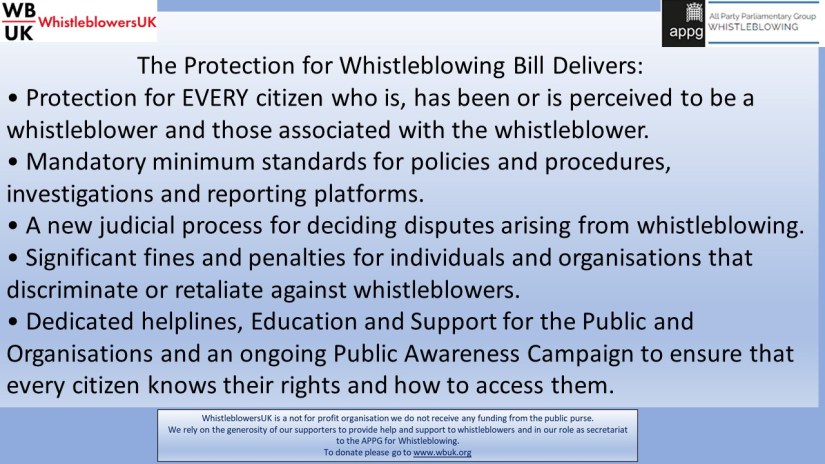
I urge everyone with an interest to read the Bill itself and decide on your position based on the facts.
🔵 Read the Bill here: https://t.co/mIE77bjNTV
🔵 Read the APPG Report on the Bill here: Whistleblowing The Personal Cost of Doing the Right Thing and the Cost to Society of Ignoring it WWW: https://www.wbuk.org/s/APPG-WB-Cost-of-doing-the-right-thing.pdf
Find out more here:
🔵 WhistleblowersUK: www.wbuk.org
Frequently Asked Questions [FAQs]:
1. Will the Office of the Whistleblower [OWB] operate like an Ombudsman?
NO. The OWB will support the work of the Ombudsman by identifying themes and areas of concerns, and by setting standards for investigations.
2. Will the Office of the Whistleblower be ‘another regulator’?
NO. The OWB will provide independent scrutiny of whistleblowing which will help support the work of regulators and bring together the various ‘speak up’ initiatives that are in place.
3. Which whistleblowers will be protected by the Office of the Whistleblower [OWB]?
The OWB will protect all citizens, putting an end to the limitations and restriction set out in PIDA which limits who can be helped and who is protected. Under PIDA protection afforded is only in respect of breaches of contract between employer and employee. This approach doesn’t represent the realities of the modern world and the complexities of areas such as healthcare where the customers / patients / users of services have a key role in shared decision making.
4. Will the Office of the Whistleblower only focus on high profile cases and senior people?
NO. The OWB will be available to all citizens. Currently many whistleblowers are denied protection because they are not workers. These include families like those at Gosport Memorial Hospital, residents of Grenfell Tower, and the families of victims of Maternity failings.
5. What will happen to whistleblower who were / are being protected by the Public Interest Disclosure Act when it is scrapped?
There will be a planned transition to ensure nobody is disadvantaged by the repeal of PIDA.
6. Wouldn’t it be simpler, and just as effective, to amend PIDA?
NO. Whistleblowing is not an employment issue!
Employment Tribunals cannot take action or make decisions about the merits of a protected disclosure and even if they could there are serious consequences for the public interest.
PIDA is unamendable. PIDA is expensive, limited in scope and beyond the reach of most whistleblowers. It is also overly complex, with cases currently waiting for over 2 years to be heard. As a result, employers can (and do) game the system by exhausting and running whistleblowers out of funds.
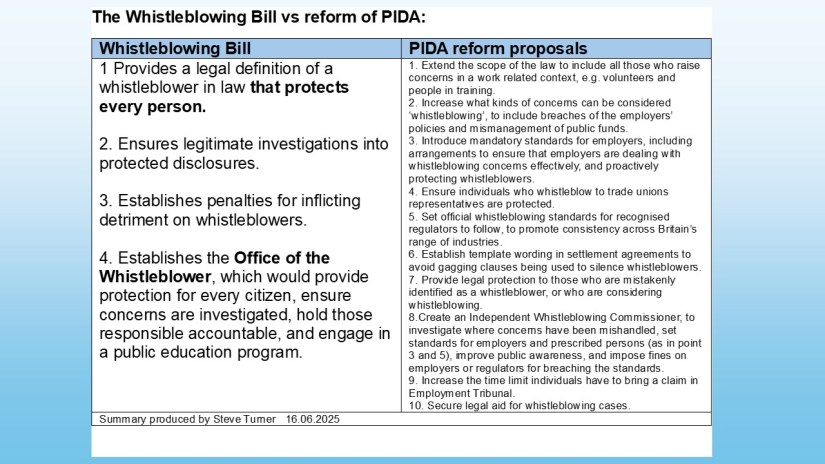
The Whistleblowing Bill tackles the root causes of the problems. It’s more inclusive, simple and clear. As shown in this comparison:
7. Are the measures in the Protection for Whistleblowing Bill based on the US ‘bounty hunting’ model of rewards for whistleblowers? No.
The Bill was informed by evidence from the UK and around the world. This includes whistleblowers themselves as experts by experience.
8. What is meant by ‘restitution’ for whistleblowers?
The word restitution means the restoration of something to its original state. This most accurately describes what the Office of the Whistleblower will aim to achieve. The objective is restoration of whistleblowers to the state they were in, or would have been in, had it not been for the fact they had to blow the whistle on wrongdoing.
There will be additional ways to recognise whistleblowers as part of the drive to normalise speaking up. Talk of rewards, bounty and compensation has dominated the negative narrative against change and does not reflect the real objective of Office of the Whistleblower, provision of a robust and comprehensive response to detriment imposed on whistleblowers.
9. Will the Bill and Office of the Whistleblower open the floodgates to people with a grudge and to spurious claims?
NO. The Bill includes checks and balances to be fair to all parties and contains a provision to exclude frivolous, malicious or vexatious whistleblowing claims.
10. Will the Protection for Whistleblowing Bill end the practice of ‘gagging’ whistleblowers through non-disclosure agreements [NDAs]?
YES. It is an important and integral part of the Bill that will address the practice of suppressing whistleblowing.
N.B. the new law will improve compliance that has so far been absent.
11. How will the Office of the Whistleblower be funded?
The Office of the Whistleblower will be set up by the Secretary of State and initially funded by government. As time progresses the Office will become self-sufficient, being funded by fines imposed on organisations that fail to be compliant.
The Office of the Whistleblower will not receive sponsorship funding or be linked to specific organisations in a way that compromises its integrity.
12. Does the Bill define whistleblowing?
YES. One of the major failings of PIDA was the failure to use simple terms that everyone understands including defining whistleblowing and whistleblowers in law. This has watered down workers’ rights in an already ineffective law and left the rest of the public unprotected.
13. Under the Bill can people still make a protected disclosure, and who will the ‘prescribed persons’ be?
YES. To support this, the definition of ‘prescribed persons’ is changed to ‘relevant person’. This removes the constraints set out in PIDA which cause confusion and are used by employers to game the system.
14. How will the independence of the Office of the Whistleblower be maintained and monitored?
Accountability for the Office of the Whistleblower rests with the Secretary of State, who is accountable to Parliament, and to the electorate.
Section 5 of the Bill sets out the governance arrangements.
15. Will the Office of the Whistleblower be funded by industry (e.g., law firms)?
NO.
16. Will the Office of the Whistleblower replace Employment Tribunals?
NO. The OWB will be specifically for whistleblowing to ensure that public safety matters and retaliation are dealt with by an organisation that is properly equipt to do so. The OWB will put an end to inappropriate, and hugely expensive, use of Employment Tribunals to address whistleblowing concerns, (other employment matters including pay and discrimination will remain the jurisdiction of the ET).
17. What powers will the Office of the Whistleblower have?
The Office of the Whistleblower will have teeth. This includes powers to issue information notices and action notices, will have the power to impose civil and refer criminal offenses.
18. Can people appeal against the decisions of the Office of The Whistleblower?
YES. Part 3 of the Bill sets out the process for first and second tier appeals tribunals.
19. Why do we need another organisation for whistleblowers?
We don’t, The Office of the Whistleblower is a new type of body that provides independent oversight of whistleblowing and does not duplicate the work of other bodies. The overall aim of the OWB is to ensure that the public interest is protected. The work of the OWB will enhance and support all existing organisations including regulators and law enforcement.
20. What happens if whistleblowers cannot afford to pursue their case?
The OWB is a free service and will adjudicate on issues of retaliation and detriment. The Bill sets out additional support for workers who can claim ‘interim relief orders’ to offset immediate financial or other hardship.
Part 11 of the Bill sets out the process for first and second tier appeals tribunals.
21. How will an Office of the Whistleblower cope with the inevitable deluge of requests for help, without becoming overwhelmed?
‘The strength of the Office of The Whistleblower [OWB] lies in its ability to formally request information, commission investigations, mandate action and set standards. For the first time, the Protection for Whistleblowing Bill defines whistleblowing and includes statutory powers. The Bill introduces civil penalties for whistleblower victimisation and a new criminal offence for any person who intentionally or recklessly submits a person to detriment.
The Office of the Whistleblower is a new type of body that provides independent oversight of whistleblowing. This will help unearth the root causes of whistleblower victimisation and drive forward actions to prevent a recurrence.
The inevitable deluge of requests for help will be welcome. For the first time, these can be investigated scrupulously and effectively. Accountability will be highlighted, and lack of accountability called out publicly. This will be backed up by the development of core principles and standards for effective education and learning.
The strength of the Office the Whistleblower is that it will not be a regulator, and not replace existing successful initiatives or organisations. The work of the OWB will support them. When it comes to healthcare, patient safety will be the focus, and the inappropriate use of employment law to cause detriment to genuine whistleblowers will become a thing of the past. This includes ending non-disclosure agreements [NDAs] for whistleblowers.
The Bill is not simply a replacement for the Public Interest Disclosure Act 1998 [PIDA], it will change the landscape and offer an innovative, evidence-based approach based on the four pillars of:
- Protection for whistleblowers
- Investigations
- Accountability
- Education ‘
This summary was produced by Steve Turner, RGN, RMN, Ba(Hons), P.G. Dip Ed. Member and former Co-Chair the WhistleblowersUK Healthcare Quality & Safety Focus Group.
About the Author:
Steve began his professional career as a nurse at St George’s Hospital in London in 1981. He also spent a decade working on hospital clinical systems for the American giant Shared Medical Systems, progressing from project manager to Senior Strategic Services Consultant of the U.S. arm of the company. In 1999 he returned to work for the NHS, successfully revamping the Information and Technology department at an NHS Trust prior to a trust merger. A spell in consultancy for a large Cancer Network followed, by leading highly successful multi-organisational projects. In 2002 Steve returned to clinical practice becoming a nurse prescriber in a Mental Health Assertive Outreach Team. In 2014 Steve founded Care Right Now (CIC) a Social Enterprise Company delivering values-based consultancy and developing patient focused clinical education services. The company’s work embraced all of health and social care, ranging from substance misuse to community paediatrics to care homes. Steve is now semi-retired and writing on ‘patient led care’.
About WhistleblowersUK
WhistleblowersUK is the UK’s only Not for Profit organisation. It was set up in December 2014 to provide help, information and support to whistleblowers and in November 2015 launched its campaign for the introduction of an Independent Office of the Whistleblower.
WhistleblowersUK receives no government funding for its work and relies on the generosity of whistleblowers, supporters and the public to maintain its work including support for whistleblowers and development and advancement of policy. Please support us by donating here and by joining our thriving associate membership and getting more involved in transforming whistleblowing.
For more information, please visit the WBUK website: www.wbuk.org or
email us: secretary@wbuk.org Press Enquiries to: ceo@wbuk
References:
- UK Parliament (2023) Protection for Whistleblowing Bill [HL] WWW: https://bills.parliament.uk/bills/3184 (accessed 16.08.2023)
- UK Government (1998) The Public Interest Disclosure Act 1998 [ PIDA ] WWW: https://www.legislation.gov.uk/ukpga/1998/23/contents (accessed 16.08.2023)
- Halliday, J (2023) Lucy Letby: how did a nurse commit such unthinkable murders? The Guardian Fri 18 Aug 2023 WWW: https://www.theguardian.com/uk-news/2023/aug/18/lucy-letby-how-did-a-nurse-commit-such-unthinkable-murders (accessed 23.08.2023)
- Halliday, J Blight, G Fischer, H & Kirk, A (2023) Timeline of Lucy Letby’s attacks on babies and when alarm was raised The Guardian Fri 18 Aug 2023 WWW: https://www.theguardian.com/uk-news/ng-interactive/2023/aug/18/lucy-letby-timeline-attacks-babies-when-alarm-raised (accessed 23.08.2023)
Document Revision Listory:
Version 2 – 19.02.2024 – Question 21 added.
Version 3 – 16.06.2025 – Section 6 updated adn footnote amended.
 Steve Turner's blog site