Accountability, clinical education, Clinical Governance, dutyofcandour, Ethics, health, healthcare, Law, nhs, patients, robbieslaw, whistleblowing

Patient safety. The missing connections.

Summary

The UK health service is often criticised for working in silos. Patient safety campaigners, policy makers, and support organisations, frequently do the same.

This opinion piece sets out a way supercharge patient safety improvements. It contains no new ideas. It does not introduce radical new methods or propose new ways of working. It is about joining together initiatives, and sharing learning, to help build and expedite evidence-based improvements. This article outlines the four pillars model and how to validate it and use it in practice. It is a call to action that challenges the patient safety world to be more inclusive, engage openly across professions and disciplines, and include patients.

The missing connections

Whether you work in healthcare or are a patient, relative, or carer, most of us recognise the problems caused by silo-working.

As a result the failure of teams and services to link up, major improvements that can prevent harm are delayed, or lost. Hardly a week passes without another example of preventable harm to patients appearing in the media. Reports from investigations and inquiries reveal that records are altered or concealed to hide the facts; staff who attempt to blow the whistle and are bullied out of their jobs; initial investigations are of poor quality (or even not carried out at all); and throughout this whole process patients are kept in the dark.

This problem is not unique to healthcare. In all sectors, from the post office to criminal justice, leadership behaviours that contribute to harm are the same. This architecture of harm1 spans four areas: duty of candour (telling the truth): attitudes to whistleblowing: the quality of investigations and patient access to records. These areas are generally considered, and acted on, in isolation. This is where the idea of the four pillars for safer healthcare comes from.

What are four pillars of patient safety?

1.Duty of Candour

The call for an individual legal duty of candour (duty to tell the truth) on public officials, was first identified as a legal gap in 2000 by the European Court of Human Rights following the death of Robbie Powell in 19902. As a result, the Robbie’s Law campaign for an individual legal duty of candour in healthcare was set up3.

In healthcare the current NHS duty of candour, created following reviews by Sir Robert Francis, delivered a watered-down duty of candour which mandates organisations rather than individuals to be truthful4.

A common misconception is that the Francis’ reforms delivered Robbie’s Law. They did not. The duty of candour introduced in 2008 falls short of what is needed and does not deliver Robbie’s Law, which is individual legal accountability to tell the truth. This wrong view is convenient for politicians, health chiefs and policy makers, several of whom have claimed, or implied that a Robbie’s Law is in place5.

The gap, whereby public officials do not have a legal duty to be truthful, first identified in the Powell case2 was later taken up in the campaign for a Hillsborough Law. Like Hillsborough, exposure of healthcare failings and the decades long struggles which victims are forced to undertake to achieve independent investigations are well documented. When enacted it is anticipated that Hillsborough Law, (the Public Office (Accountability) Bill6), will meet the requirements of a Robbie’s Law.

2. Protection of whistleblowers

A culture of cover-up means that those who have suffered harm have to rely on staff to speak out and blow the whistle. This does not always happen, because healthcare whistleblowers risk losing their careers and being blacklisted when they expose the truth. UK healthcare failings that have caused avoidable harm, and the exposure of subsequent cover-ups by whistleblowers, link duty of candour to the whistleblowing agenda. Campaigns to support whistleblowers by various individuals and organisations led to demands for changes in the law, including the Whistleblowing Bill which is currently going through parliament7.

Both the initiatives on duty of candour and on whistleblower protection legislation are usually dealt with separately. The link between the two in the NHS is under-acknowledged and is rarely recognised in the debates and discussion forums. It is now seldom mentioned in the press, or referred to by commentators5.

3. Independent Investigation Process

There is a growing movement advocating an independent investigation process in healthcare, to end of the practice of the NHS marking its own homework8. The importance of a high quality, consistent, independent investigation process is included in the 2025 NHS plan9. The most well evidenced example of this unmet need is the Robbie Powell case which, 36 years after Robbie’s death, remains unresolved. This is despite overwhelming evidence of wrongdoing, much of which is proven3.

The NHS complaints process is based on the organisation investing itself in the first instance, and routes to a fully independent investigation (statutory or non-statutory) are unclear. This is compounded because the NHS does not have an overarching competency framework that applies to investigations. Currently, there are no common standards for collecting information, taking, and recording statements, or for selecting appropriate expert witnesses.

4. Patients’ access to their medical records

When healthcare failings require scrutiny and action: the accuracy, completeness, and timely availability of patients’ medical records are crucial. The 2026 NHS plan refers to linking patient records and giving patients real-time access9. This is long overdue. Avoidable harm to patients is caused, or made worse, because patients do not have real-time access to their medical records. Plus, medical records are stored on multiple systems, many of which are not linked. As a result, patients are denied the opportunity to be active participants in their own care and are unaware of clinical red flags which require urgent attention.

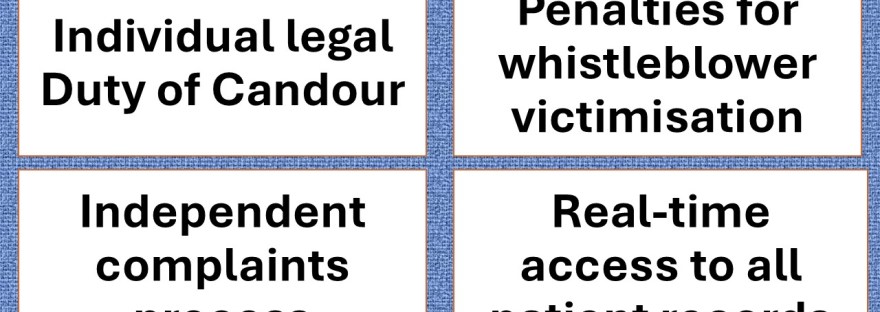
In summary, these four areas:

  • Individual legal Duty of Candour legislation
  • Protecting whistleblowers from victimisation
  • An independent investigation process
  • Patient access to their medical records in real-time

are inextricably connected.

The missing links

As it stands in 2026, health leaders and professionals have no individual legal duty to be truthful; victimising whistleblowers is not (in itself) against the law; the NHS investigation process lacks independence and lacks quality assurance, and patients do not receive all their records in real time.

It is my professional opinion that this is a harmful situation, and that it is dangerously incomplete to discuss duty of candour in healthcare without referring to whistleblowing, to the investigation process and to patient record access.

Progress is being made

Actions are underway on each of the four pillars. The Public Office (Accountability) Billis expected to become law6. Legal protection for genuine whistleblowers and penalties for those who have proven to have victimised whistleblowers is contained in the Whistleblowing Bill7 and there are a range of proposals to amend related laws, including the Public Interest Disclosure Act10. The 2025 NHS Plan signals in need for an independent complaints process, supported by legislative changes, and the need to make all records available to patients in real-time, supported by legislation, is also signalled in the 2025 NHS plan9.

Despite all the initiatives, very few people join up the four pillars. I have been unable to find examples where the four pillars are brought together in discussions: meetings: policy forums: round table events: workshops: training sessions etc. All too often each pillar is studied, reviewed, and acted on separately. Very few commentators, policy makers, and patient safety organisations step back to take a wider view5.

Evaluating the four pillars model

Here are two ways to evaluate the validity of the four pillars of patient safety. These reflective exercises, taken from my inter-disciplinary teaching work, have proven popular. Feedback from teaching sessions conducted using this approach included clinicians stating that what they had learned led them to change their practise, and patients noting that their care and treatment has improved as a result.

  1. Retrospective analysis:

Take any example of avoidable harm, study the evidence, and ask what would have been different if:

  • Managers, leaders, and healthcare professionals were each legally obliged to tell the truth.
  • Staff had been able to speak out and, where necessary, blow the whistle without fear of retribution.
  • There was a consistent, high-quality independent investigation process.
  • All records had been available to the patient (or their legal representative) in real-time.

B. Relating the four pillars to current practice

First, consider instances you have experienced where preventable harm was avoided, or mitigated, and reflect on this using the four pillars model. By looking in detail at areas of good practice it is possible to confirm if lessons have been learned, and if changes in practice have improved outcomes.

Then go on to consider whether these changes in practise are widely adopted, and what is needed if this is not the case.

Call to action

I urge everyone, in every profession and field of work, with an interest in patient safety and accountability to collaborate and look at it from the perspective of the four pillars of patient safety. These are not new ideas, and they each have an evidence base. The four pillars are not current buzzwords or fads. They have been around for a long time. This is about putting best practice into action by opening the debate to everyone involved, spanning organisational and professional boundaries.

Whilst there are differences of opinion on how to achieve change and prevent harm to patients, the baseline is the same. Who can argue against honesty, fairness, independent scrutiny, and who opposes patients receiving copies of their own records?

My advice to patient safety campaigners, policy makers and healthcare organisations is, before you begin: check your idea, your initiative, your workshop, meeting, teaching session etc., against the four pillars of safer healthcare.

  • Have you involved the right people?
  • What are your aims and objectives?
  • How will you evaluate progress?

Here’s the wake-up call. Consider the four pillars at the outset of all patient safety initiatives. Work across boundaries. Join up initiatives. Always involve patients, carers and relatives, and structure initiatives around this. Set up events that bring people together who would not normally meet.

Adopting the four pillars approach builds links between stakeholders from the outset. It will enhance what you are trying to achieve, and the benefits will soon become clear.

Author: Steve Turner

carerightnow@gmail.com

Date: 14.08.2026 Version:1a

References

  1. Newell, J (2026) The Architecture of Harm Systems Under Strain & the Search for Accountability – The moment the System Broke Substack WWW: https://jennewell1.substack.com/p/the-moment-the-system-broke (Accessed 13.08.2026)
  2. European Court of Human Rights (45305/99) (4th May 2000) – (Third Section) – Decision – POWELL v. THE UNITED KINGDOM 
  3. Turner, S (2026) Robbie’s Law – Telling the Truth in Healthcare. The Campaign for an Individual Legal Duty of Candour. Available at: www.robbieslaw.com  (Accessed 13.08.2026)
  4. UK Government (2008) Health and Social Care Act 2008 (Regulated Activities) Regulations 2014, Regulation 20 (Duty of Candour).
  5. Turner S (2006) Truth, Accountability, and the State: Revisiting the Robbie Powell Case Through Law, Ethics, and Public Administration (Patient Safety Learning – Hub) Also available at: https://medicinegovorgmedlearninnovationeventnhsblog.wordpress.com/wp-content/uploads/2026/06/truth-accountability-and-the-state-robbie-powell-robbies-law-web-site-v1.pdf (Accessed 13.08.2026)
  6.  UK Parliament Public Office (Accountability) Bill 2024–26. WWW: https://bills.parliament.uk/bills/4019  (Accessed 13.08.2026)
  7. UK Parliament (2026) Whistleblowing Bill [Bill 151] 2023 – 2026 WWW: https://bills.parliament.uk/bills/3676 (Accessed 13.08.2026)
  8. Keeping the NHS Honest www: https://www.keepingthenhshonest.co.uk/ (Accessed 13.08.2026)
  9. Department of Health (2025) 10 Year Health Plan for England: fit for the future www: https://www.gov.uk/government/publications/10-year-health-plan-for-england-fit-for-the-future  (Accessed 13.08.2026)
  10. UK Parliament Public Interest Disclosure Act 1998 WWW:https://www.legislation.gov.uk/ukpga/1998/23/contents (Accessed 13.08.2026)
Accountability, clinical education, Clinical Governance, dutyofcandour, Ethics, health, healthcare, Law, nhs, patients, robbieslaw, whistleblowing

Why Patient Safety Demands a Hillsborough Law – With a Legal Duty of Candour for All Health and Care Professionals

No legal duty to tell the truth

More than three decades after the preventable death of 10-year-old Robbie Powell and the subsequent cover-up by medical professionals, the UK still does not have a legal mechanism to hold individual clinicians accountable for dishonesty. The proposed Hillsborough Law1 – which seeks to establish an individual legal duty of candour on public officials – must include all health and care professionals: managers, leaders, and frontline clinicians alike. Anything less would be an affront to patient safety and public trust.

The heartbreaking story of Robbie Powell, who died in 1990 due to multiple clinical failings, has long been a call to action for legal reform2. His case, meticulously documented and campaigned for by his family, exposed how doctors could mislead families and official inquiries without legal consequence3. The European Court of Human Rights ruling on Robbie’s case made it chillingly clear: there is no individual legal duty of candour on doctors4. The media aptly dubbed it “a doctor’s right to lie.”5 This remains true today.

A conspiracy of silence?

Robbie’s death occurred a year and two days after the Hillsborough tragedy. It is the landmark case on a legal duty of candour. The issue was first raised by the Powells in the UK Courts from 1996 onwards, and then submitted to the European Court of Human Rights in 2000. This pre-dated the call for a legal duty of candour by the Hillsborough families. Yet the call for a Robbie’s Law receives little attention in the press and media. It was referred to by Sir Robert Francis in the report on the failings at Mid Staffordshire6, and the significance of the Robbie Powell case was a factor in the collapse of the 2021 trials of former police officers and a solicitor involved in the Hillsborough disaster7.

After Hillsborough the Robbie Powell case, through its influence on the concept of ‘duty of candour’, played a role in the broader discussions around transparency and accountability in public life. Because there was (and still is) no individual statutory duty of candour on police officers or public officials, the legal framework made it easier to defend against allegations of dishonesty or misconduct, even when unethical behaviour was clear.

That such a crucial legal precedent draws so little public attention is telling. It highlights how deeply entrenched the culture of denial and protection is, not only in policing but across public institutions — including the NHS and the whole of health and social care.

The argument against legally enforced accountability

Some clinicians argue that a statutory duty is unnecessary. In fact, in 1998 a British Medical Association spokesperson publicly defended this view, claiming that ‘the ethics of this are rather more important than the law’ and a strict legal framework would be ‘unhelpful’8. Sadly, history proves otherwise.

In a parallel situation on public accountability, the Post office scandal9, where countless subpostmasters were failed by Post Office leaders and managers who stayed silent, showed the cost of misplaced institutional loyalty. Healthcare has its own shameful examples, including the Infected Blood Scandal10, the widespread mistreatment of people with autism and learning disabilities, and shocking failures highlighted in multiple reports and other systemic scandals examined in the Thirwall11 and Lampard12 inquiries. Again and again, professionals have failed to speak out — and when they do, they are often ignored and even blacklisted12.

This is not a question of bad apples; it is a systemic failure of accountability. Without a legal duty of candour that applies to individuals, there is no deterrent to dishonesty and no justice for those harmed by it. Regulatory bodies have repeatedly proven they are not enough.

Time to act – Hillsborough Law incorporating Robbie’s Law now!

A Hillsborough Law that excludes clinicians from individual accountability would betray the very purpose of the legislation. It would ignore the hard lessons from decades of cover-ups, including the tireless efforts of Robbie Powell’s family to expose the truth. We cannot afford to continue a system where telling the truth is optional, and silence carries no consequence.

Patient safety depends on truthfulness. And truthfulness must be enforceable — not merely expected.

References:

  1. UK Parliament (2025) Public Authority (Accountability) Bill ‘Hillsborough Law’ www: https://bills.parliament.uk/bills/1978 (accessed 28.07.2025)
  2. Robbie’s Law – Telling the truth in healthcare. The campaign for an individual legal duty of candour. (2025) www: robbieslaw.com (accessed 28.07.2025)
  3. Hartles, S (2023) ‘Robbie Powell: Time for Truth, Justice and Accountability’ The Open University, Harm & Evidence research collaborative. WWW: https://www5.open.ac.uk/research-centres/herc/blog/robbie-powell-time-truth-justice-and-accountability (accessed 28.07.2025)
  4. European Court of Human Rights (45305/99) (4th May 2000) – (Third Section) – Decision – POWELL v. THE UNITED KINGDOM  www: https://robbieslaw.com/wp-content/uploads/2024/02/european-judgment-powell-4-may-2000-1.pdf (accessed 28.07.2025)
  5. Hammond, P January 25, 2013 Robbie’s Law – Telling the truth about medical harm Private Eye: Medicine Balls 1332  www: https://www.drphilhammond.com/blog/2013/01/25/private-eye/private-eye-medicine-balls-1332/ (accessed 28.07.2025)
  6. UK Government (2013) Report of the Mid Staffordshire NHS Foundation Trust Public Inquiry  www: https://www.gov.uk/government/publications/report-of-the-mid-staffordshire-nhs-foundation-trust-public-inquiry  (accessed 28.07.2025)
  7. The Guardian (2021)  Hillsborough families attack ‘ludicrous’ acquittals of police www: https://www.theguardian.com/football/2021/may/26/hillsborough-trial-of-former-south-yorkshire-police-officers-collapses (accessed 28.07.2025)
  8. You tube playlist (1998) Channel 4 News 24th April 1998 – Duty of Candour [Robbie’s Law]!  Relevant section at 9.09 www: https://youtu.be/gVISXMJUocA?list=PLPtuApYs79-6ie3tnwTpONsxjzc5ooG4d (accessed 28.07.2025)
  9. Post Office Horizon IT Inquiry (2025)  Homepage Post Office Horizon IT Inquiry  www: https://www.postofficehorizoninquiry.org.uk/ (accessed 28.07.2025)
  10. Infected Blood Inquiry (2025) Infected Blood Inquiry: Homepage www: https://www.infectedbloodinquiry.org.uk/  (accessed 28.07.2025)
  11. Thirwall Inquiry (2025) Thirwall Inquiry: Homepage www: https://thirlwall.public-inquiry.uk/ (accessed 28.07.2025)
  12. Lampard Inquiry (2025) The Lampard Inquiry is an independent statutory inquiry investigating the deaths of mental health inpatients in Essex between 2000 and 2023 www: https://lampardinquiry.org.uk/  (accessed 28.07.2025)
  13. Turner, S (2023) The systemic silent killer – ending the stigma around whistleblowing in healthcare www: https://medicinegovorgmedlearn-innovation-event-nhs.blog/2023/10/13/the-systemic-silent-killer-ending-the-stigma-around-whistleblowing-in-healthcare/   (accessed 28.07.2025)

Robbie’s Law web site: http://www.robbieslaw.com

Author: Steve Turner – Version: 2 – Posted here 02.02.2026

Accountability, clinical education, Clinical Governance, dutyofcandour, Ethics, health, healthcare, nhs, patients

Identifying bullying – ‘Secret squirrels’

Although I’m not an academic and haven’t studied bullying in depth, I’ve experienced it and I’ve also been in situations where, I now recognise, I took a bullying approach. This has led me to consider the difference between accountability and bullying:

Accountability
The key thing for me is the difference between holding people to account (e.g., by openly discussing problematic beliefs and behaviours) and bullying. 

Accountable actions are driven by the intention / motivation of helping all involved and building an interconnected community based on honesty and trust. (‘Tough love’ if you like).

‘Secret squirrels’
Contrast this to the scenario where bullies criticise people without being specific about what’s being questioned, act secretly and withhold information, blacklist people, create over complex rules which can’t be followed and hide behind bureaucracy and hierarchy.

Specific bullying behaviours include undermining, whispering campaigns, behind closed doors conversations etc.

Look out for cultures where the modus operandı is ‘kiss up – kick down’. If this is the case, the organisation has problems. It will not be able to deliver its aims effectively and may be creating an unsafe environment.

In my experience, around the time of my protected disclosure, I was involved in meetings and discussions where those who had set up the meeting had not stated the purpose of the meeting in advance (or on one occasion deliberately misled me). In these meetings they had clearly rehearsed their questions. Questions that were designed to belittle and discredit.

Sounds familiar?

In these cases, this seems to be motivated by a desire to cling on to power, deny failings, use ‘playground’ tactics and break connections which aren’t in line with the overall agenda (often not made public).

These behaviours are frequently the result of bullying from higher up the chain, and a culture where leaders are not comfortable with ambiguity.
Bullying in this context is not always recognised as such, and victims are made to feel it may be their fault. This compromises patient safety.

Bullying is a problem which affects all areas of work, and all sectors. I remain optimistic that, because of the profile this issue now has, things are changing. There’s a long way to go yet, and many injustices to be rectified.

‘People deal far better with uncertainty and stress when they know what’s going on, even if the information is incomplete and only temporarily correct. Freely circulating information helps create trust, and it turns us into rapid and more effective learners’

Margaret J Wheatley (2007) ‘Finding our Way. Leadership For an Uncertain Time’. Berrett-Kohler Publishers Inc. San Francisco

Last updated: 07.010.2025

clinical education, Clinical Governance, Community Care, health, healthcare, medicines, nhs, paediatrics, patients, prescribing

Children’s medicines in the community – medicines incidents and near misses

How listening to parents led to safer care

Case Study:

Background:
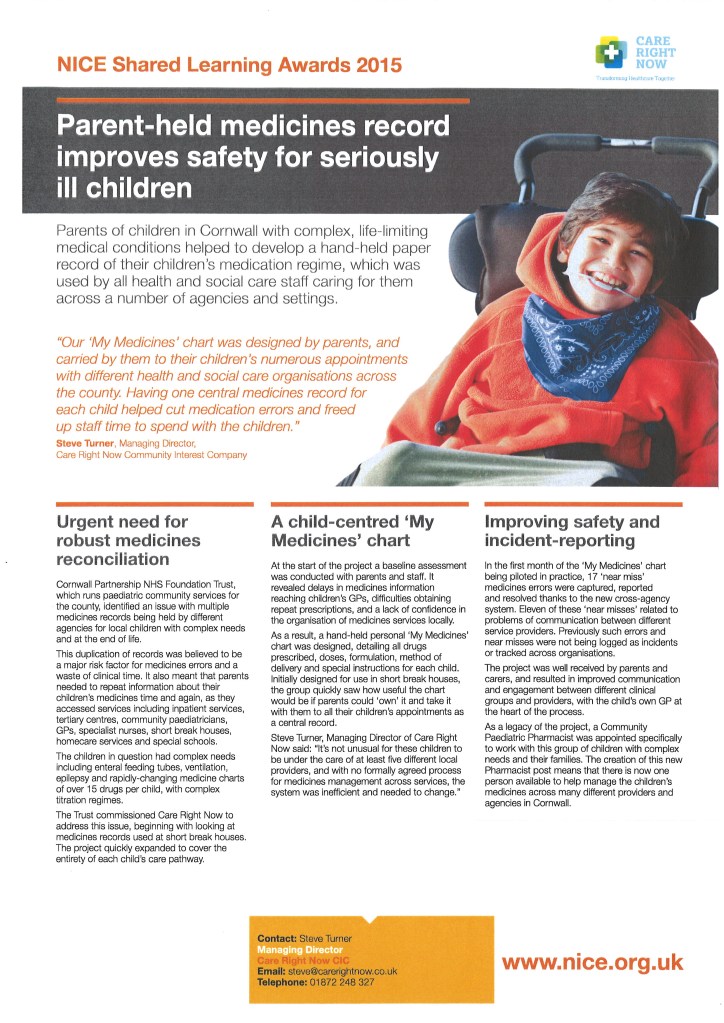
From 2008 to 2014 my company ran education sessions on managing medicines in a mental health trust. In common with some other mental health trusts the provider also looked after paediatric community services. This is not a mental health service. It covers children with complex health needs including enteral feeding tubes, ventilation, epilepsy and rapidly changing medicines.

Children under the care of this service may be taking in excess of 15 different medicines per day, have complex titration regimes, emergency drugs with associated care plans, plus numerous ‘as required’ (prn) medicines.

It is not unusual for children with complex conditions to be under the care of up to five different providers, and to move between three different providers in one day. For example, from a Home Care Service to the Special School, to a Short Break House, also being seen in an Outpatient Clinic on the same day too. As a result, parents frequently have to repeat the information on their child’s medicines every time they move to another service, or a new person is involved.

Where to start?
The idea for change came about because of concerns that the staff in Children’s Short Break Houses were not learning what they needed about children’s medicines, as the learning was geared to the majority of staff who worked in mental health. So a new learning package for children’s staff was commissioned.


Part of the work to design the learning package included a baseline assessment which was conducted with parents and staff. This soon revealed that training alone was not the answer. It showed delays in medicines information reaching GPs, workarounds for obtaining information in order to administer medicines in the houses and a general lack of confidence in the whole process.


As a result, we looked at the whole system starting with the area where most concerns had been raised, which was having an up-to-date complete list of a child’s medicines available at all times (medicines reconciliation). The system in place for Short Break Houses involved paying a local GP (not usually from the child’s GP Practice) to write up a medicines chart for each child. The process was fraught with difficulties and delays and widely disliked by everyone directly involved.


So we set about looking for a new way to manage the lists of medicines with more training and more input for the staff in the services involved. We came up with a new (and much more robust) process for medicines reconciliation in the Short Break Houses. This was fully documented in a new policy and involved cross-checking by both the staff and the parents.

Just before this went live, we asked the parents to review and comment on it and they said:
‘If you’re producing an accurate and up-to-date list of my child’s medicines, why keep it the Short Break House, can’t it go with my child?’
So, the My Medicines chart, which travels with the child, was born.

What was involved?
The My Medicines process led to the design and production of a new chart which has to be signed and checked by the parents.
It resulted in 40 children with complex conditions being offered a hand held paper record of their medicines (produced and validated by clinicians), which they take around with them wherever they go.

Benefits:
The new process, which continues to evolve, means that the child’s GP is now directly involved in day-to-day medicines reconciliation (they weren’t before); the parents are always asked to check and sign the charts (they weren’t before); verbal messages about medicines are never taken, and incomplete (or missing) directions are rapidly rectified (never worked around).


Some specific benefits of the new process included:
• It reduced the risks of error, by providing full and accurate information on children’s medicine across their entire pathway.
• It cut out the need for parents to keep having to repeat what medicines their child is taking to different professionals and care agencies.
• It freed up medical and clinical time which was previously spent chasing missing information.
• It reduced the number of third-party handovers and transcribing of prescription information.

Looking back, it’s hard to believe that the old ways of working, which caused so many difficulties (especially for front line staff), were carried out for so long. These risky practices, or similar, are believed to still be commonplace in England.

Revealing hidden incidents and near misses:

In the first month of the project we raised 17 medicines incidents or near misses. Of these 11 related to problems with communication of information across the child’s pathway.

Resolving these has resulted in improved communication and engagement between different clinical groups and providers, and a desire from all quarters to take the project further. Previously many of these incidents were not logged or tracked across organisations. In some cases, it was only due to the vigilance of the staff and parents that they were spotted, and errors avoided.

Accepting the changes:

The project was well received by parents and staff and resulted in improved communication and engagement between different clinical groups and providers. This included the Consultant Paediatricians (working for the secondary care provider), who were initially sceptical.


The project was less well received by the relevant medicines and prescribing committees, who were understandably concerned about who owned the My Medicines chart and had agreed to its content. Explaining this was made more difficult because it is hard to get across the complexity of the arrangements, due to the critical nature of the children’s illnesses, in a committee setting.


I make no apologies for ensuring from the outset that it was the parents who owned the charts, which were designed by the project team (not a committee) to meet all best practice standards. It always worries me that when it comes to cross- organisational working the formal committees and systems in place can inadvertently act as a barrier to safety rather than promoting it. There is no doubt we had designed a safer process and my company was happy to take accountability for any associated risks.


As a legacy of the project, a Community Paediatric Pharmacist was appointed specifically to work with this group of children. So whatever evolves will now be based on inter-disciplinary thinking and working and will have clear safety parameters. I am grateful for the enlightened thinking of the leaders who commissioned this work and supported this novel approach.

Steve Turner RGN, RMN, Ba (Hons), P.G. Dip. Ed.

This example was included as a NICE Shared Learning resource and was highly commended by NICE in 2015.

Posted: 19.04.2023

clinical education, Clinical Governance, Ethics, health, healthcare, medicines, nhs, patients, prescribing

Evidence Based Medicine. Myths, truths and things in between – a blog for everyone

In producing a teaching session on evidence based medicine, it occurred to me that there are some important points everyone needs to know, and that they are summarised well in these videos from James McCormack. So, if you like learning through the medium of song and dance, these are for you 😃.

There are some links to important guidelines and academic references too. Some of the comments on learning points reflect my personal views.

Assessing the evidence

‘Viva La Evidence’ from James McCormack

Key learning points:

Look for absolute numbers. To assess clinical studies, you need to have sight of the ‘absolute numbers’ and the figure for Absolute Risk Reduction [ARR]. Sales and marketing people may just tell us about Relative Risk Reduction [RRR]. This figure stays constant with different populations, and always looks better. To be honest I find this concept easy to understand but hard to explain. Here’s a link to an article which goes into more detail.

POOs and DOOs. It’s helpful to look closely at the relevance of the research for patients. Is it focused on outcomes that are patient-oriented [POOs] or disease-oriented outcomes [DOOs]? Click here for a related article.


‘The End of Guidelines’ – how useful are they in real life

‘The end of Guidelines’ – from James McCormack

Key learning point:

Guidelines not tramlines

Most current guidelines are written for specific diseases and conditions when, in reality, many people often have more than one long-term condition. In fact, most people with chronic conditions, and most people over 65, have multiple health conditions. This together with other factors such as past experiences, health beliefs, ethnicity, poverty, lifestyle and cultural factors, will influence the choice of medicines.

To help with this there are some important NICE Guidelines, which should be cross-referenced in practice guidance (local and national).

  1. NICE guideline [NG56] Multi Morbidity and Clinical Assessment
  2. NICE Guideline [CG 76] on Medicines Adherence
  3. NICE Guideline on Shared Decision Making (2021)

All prescribers should be familiar with and use these guidelines in helping patients choose medicines & treatments. This includes the patient’s choice not to take a medicine, which is specifically noted in the NICE Guideline on Medicines Adherence.

Guidelines are just that – ‘guidelines’ – and not to be followed blindly without question or reference to the individual patient.


Alternatives to medicines – Choosing wisely

‘Choosing wisely’ from James McCormack

Key learning point:

‘Top-down medicine is dead’

We are best experts in our own care.

The clinician’s role has changed from being the ‘expert’ to that of a teacher, advisor, mentor and sometimes an advocate. At the end of the day, in everyday situations, what we do is our decision. The much-used phrase ‘shared decision making’ is inappropriate in my view, it stems from the old fashioned ‘doctor knows best’ attitude. I prefer to use the phrase patient led decision making.

Click here for more on our patient led clinical education work.


Steve Turner is a retired nurse prescriber and clinical educator.

Comments welcome: carerightnow@gmail.com

Click here for more links to Steve’s work

Page last updated: 21.05.2025