
Exposing the reality behind the spin
Summary
I am a retired healthcare professional, a nurse prescriber with experience in senior management in both the NHS and private sectors. I worked as a clinician with vulnerable adults on the margins of society.
Over the past two decades I’ve become involved with a situation I was previously unaware of. The widespread marginalisation and victimisation of health and care staff who raise concerns about patient safety and lose their careers as a result. I’ve learned that this problem is part of a much bigger picture which affects all of society, all industries and public sectors, in all countries of the world.
In this blog I reflect on the situation in England based on my experiences and those of the many people I have met as a result. All of whom experienced the backlash that can happen when organisational reputation trumps patient safety. One thing many of us have in common is that, put simply, we never intended to become known as ‘whistleblowers’, we were just trying to do our job to the best of our ability.
In conclusion, I look at key areas to be worked on in order to protect the public and really ‘learn lessons’. These cross all sectors and areas of work. They include the need for changes in legislation, an end to self-regulation in healthcare and elsewhere, and recognition of the value to society of those who risk everything to fight for justice and truth.
A dawning realisation
I began to realise something was seriously wrong when I returned to clinical work in 2002. Having previously worked in senior management (as Head of I.T. in an NHS Trust) and management consultancy, I became concerned that my employer appeared to be putting reputation over patient safety, and if concerns were raised, they were not followed up. I recall looking at Board papers and directions to trusts from the Department of Health [DH] to try and understand this further. One thing I remember is a letter to Chief Executives from the Department of Health which talked about creating an ‘outward facing’ organisation. I didn’t realise at the time what I now see as the real meaning of this, and its link to the ‘no bad news culture’. This involves putting reputation above patient safety.
Later I tried to raise my concerns with a Trust Executive at an early stage, only to be told in both words and body language that the trust didn’t want to hear anything bad. This attitude, and what I saw happening to the team and staff around me, led me to leave the NHS and become self-employed working for the NHS on projects related to medicines and prescribing.
The difficulties continued
Now working as a self-employed contractor I continued to experience difficulties when I spoke up for patients and patient safety. To escalate my concerns I followed the Trust policy, and the appropriate internal routes, including speaking to the Deputy Chief Executive about my concerns. The Deputy CEO was then going to arrange for me to speak to the Non-Executive Director responsible, however the Chair of the Trust blocked me from speaking to them. (This is the Chair who told me they didn’t want to ‘hear anything bad’). Eventually my experiences and increasing frustration led me to make a protected disclosure to the care Quality Commission [CQC] in 2014, in which I set out the patient safety concerns. As a result, the CQC requested that the Trust commission an external investigation of my concerns.
Since being interviewed for the investigation report in 2014 I have heard nothing further. I never saw the investigation report and was never contacted about it. A freedom of information [FOI] request to the CQC produced the response that my concerns were dismissed as ‘all third hand’ (which is incorrect) and I was told that the CQC had ‘lost the report’.
Prior to the FOI request, I was employed as a CQC Specialist Advisor (a zero-hours contract), however following the FOI request this contract was ended without a specific reason being given.
The wider picture in healthcare
I’ve only briefly mentioned some of the aspects of my story here. The most important thing for me was that I found out the common themes behind all genuine healthcare whistleblowers’ stories.
Three things stand out for me.
1. The psychological effect on the whistleblower
I experienced the isolation that whistleblowers are subjected to and the psychological effect this has on individuals. Suddenly you’re on your own, and people you worked with avoid you. In my case, I also kept my distance from some co-workers, as I realised they were being bullied as a result of supporting me.
For me offers of work dried up and a sickening feeling of being ‘sent to Coventry’ set in. In addition to the loss of income, this isolation has a deep effect on my mental health and home life. I believe the approach of employers here is called ‘gaslighting’. It’s deeply troubling.
2. The NHS cold shoulder / being blacklisted
Secondly, I have discovered through meeting other whistleblowers that blacklisting of those who speak out is very common. This can take many forms, ranging from informal blacklisting to interventions to prevent career development, to giving unsolicited (and unfair) bad references.
For those employed by the NHS the Electronic Staff Record [ESR], which is shared throughout the NHS can be used as a way of sharing detrimental information on whistleblowers. This has caused people to be denied a fair chance to gain further employment. I believe the full extent of this is yet to come to light.
In my case the blacklisting took the form of repeatedly being given the ‘cold shoulder’ for example being excluded from meetings; uninvited from regular meetings I was previously part of (without a reason being given); letters and emails not replied to, a higher education establishment being told not to engage with me, and generally being avoided. Of course, this is subjective, and sometimes I may be wrong, as healthcare is a tough work environment. However, I have been subject to some clear examples of ongoing detriment. This lasted right up to, and beyond, my retirement.
On one occasion my company was enthusiastically awarded a contract of work one day, then the very next day the same person ‘phoned me and cancelled the order saying only that it ‘wasn’t what they wanted’. Very strange. Also, I found out years later that staff from the trust I worked for were told not to speak to me, even though in some cases it was to ask me a question about my clinical work.
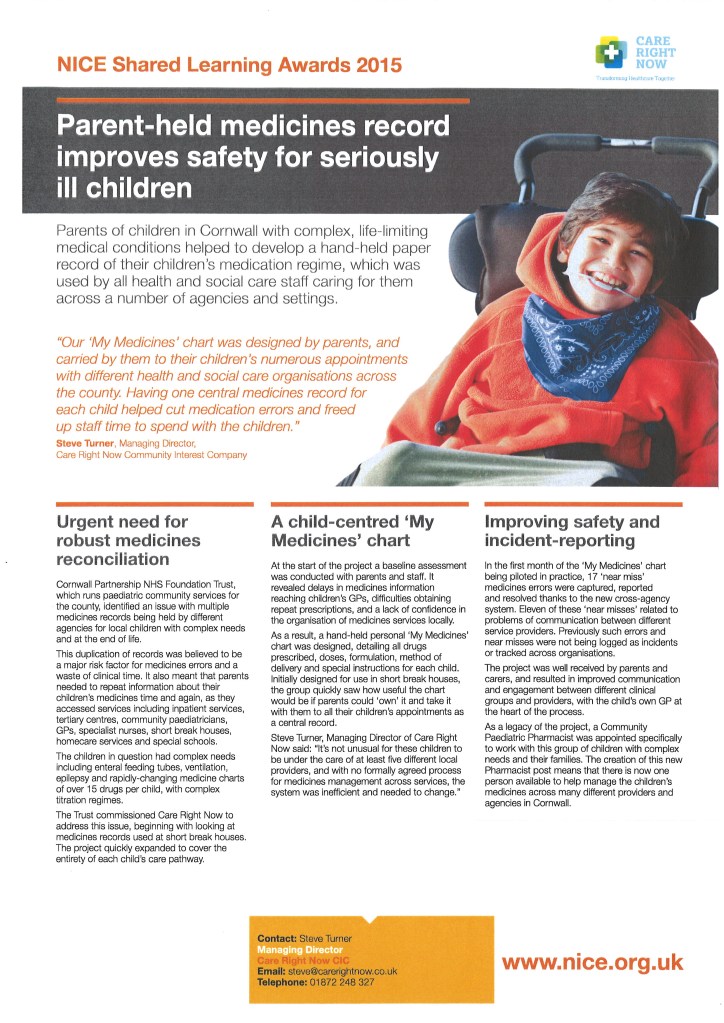
In addition, I was deeply upset when the NHS Trust, who commissioned one of my projects, failed to acknowledge its success. A poster was presented at the NICE Conference in 2015 and it was highly commended by NICE.
Prior to the Conference, I contacted the trust to let them know of the success and all attempts to engage the trust were ignored. As you can see on the poster (which was produced by NICE) the space for the trust’s logo, on the bottom left, is empty:

In fact, I had several examples of work on the NICE Shared Learning pages, none of which have ever been acknowledged in any way by local NHS Trusts, or any healthcare organisations in Cornwall.
In was fortunate in being successful in delivering the above children’s medicines project, which has had a lasting legacy – the appointment of a Paediatric Community Pharmacist. One of my protected disclosures was about this project. Specifically that I was pressured to alter a report which highlighted the urgent need for improvements in medicines’ safety. At the time there were people in senior positions who backed me up and the report remained unchanged. Since then, all these people have left the trust. More recently the trust was caught up in a ‘governance scandal’ which resulted in the Chief Executive and Board Members who had bullied me leaving suddenly.
3. The effect that the victimisation of healthcare whistleblowers has on patients
Thirdly, as I looked further into the problem, I began to see the full impact that the victimisation of genuine healthcare whistleblowers has on patients. This for me is the most shocking aspect of the problem.
In 2015 I set up the Turn up the Volume! Movement. This was an attempt to bring together all involved in an open and transparent way, with a focus on the core issue of patient safety.
Through this initiative I have met many more people in a similar situation and learned first-hand the effect lack of transparency and denial has on patients. This is well illustrated, for example, in the report of the Gosport Independent Panel Report (2018), where those who raised the alarm were initially listened to, then ignored and their concerns re-labelled as ‘allegations’. As a result of this, in the words of the report, ‘the lives of over 450 patients were shortened while in the hospital’.
Next steps
Based on my experience in trying to link together people in health and care with similar experiences and focus on patients, I believe there are three vitally important areas in healthcare that need addressing.
The need for an individual duty of candour
Firstly, I was shocked to find out that in the NHS the duty of candour (duty to tell the truth), brought in following the Mid Staffordshire inquiry, is an institutional duty of candour. This relies on staff telling the truth to their employer in order to highlight what went wrong. Thanks to the tireless work of campaigner Will Powell the need for an individual legal duty of candour for professionals, managers & leaders in healthcare has been demonstrated. This has parallels to the calls for a ‘Hillsborough Law’. Without this, there is no real mechanism to hold individuals to account for cover-ups and for not being honest.
Making sure initiatives are effective
Secondly, I’m disappointed at the failure to learn and improve patient safety through listening to genuine whistleblowers, whether they be patents or staff, and failure to take measurable actions to change. I believe that the National Freedom to Speak Up [FTSU] Guardian initiative has had unintended negative consequences. Evidence suggests that whilst many trusts are using FTSU to solve problems and make improvements, it is making the situation worse in some trusts, where it is used as a cover for continued victimisation of those who speak out.
Ending self-regulation & providing independent oversight of whistleblowing
Thirdly, in common with industry, I believe that self-regulation in health and care does not work, and the only solution will be to set up a truly independent body to oversee and enforce this. This body must involve patients, who raise concerns at great cost to themselves and their families.
Health regulators in England and the people who they regulate are often uncomfortably close. For example, I was deeply disappointed when I found out only that the CQC Inspector involved in dealing with my concerns raised in 2013, later became employed as Compliance Lead in the same trust.
Author: Steve Turner
Revised and reposted: 04.03.2026
Related posts:
‘The systemic silent killer – ending the stigma around whistleblowing: a blog by Steve Turner’ (2023) on the Patient Safety Learning Hub.
Clegg, A (2022) How cronyism corrodes workplace relations and trust Financial Times. WWW: https://www.ft.com/content/98fdcde8-eba1-45b3-98a6-eceb5269e07c (accessed 23.01.2023)

 Steve Turner's blog site