British Asians are underrepresented in clinical studies.
‘When British Asians are excluded from clinical research, Asian communities remain overlooked in cancer prevention, access to care, diagnosis, and innovative treatments. Care is less tailored and outcomes are poorer.‘
This lack of inclusion and representation means that British Asians live less well with cancer and die sooner than other people. Researchers are keen to address this.
This inequity is a major patient safety issue, which the British Asian Cancer Charity is focusing on through the BACC research focus group, which forms part of the #MyResearchLegacy campaign.
We believe that one of the most powerful ways to recruit people from underrepresented groups to clinical studies is by word of mouth and by sharing information through networking.
Opportunities to be part of research projects:
Here are details of academic research projects which relate to British Asians with cancer. Please share these with colleagues, friends, relatives and anyone who may be interested.
The REFORM study – a study working with South Asian women to explore their experiences of breast cancer and hormone therapy to understand how to improve support for South Asian women and reduce ethnic health inequalities.
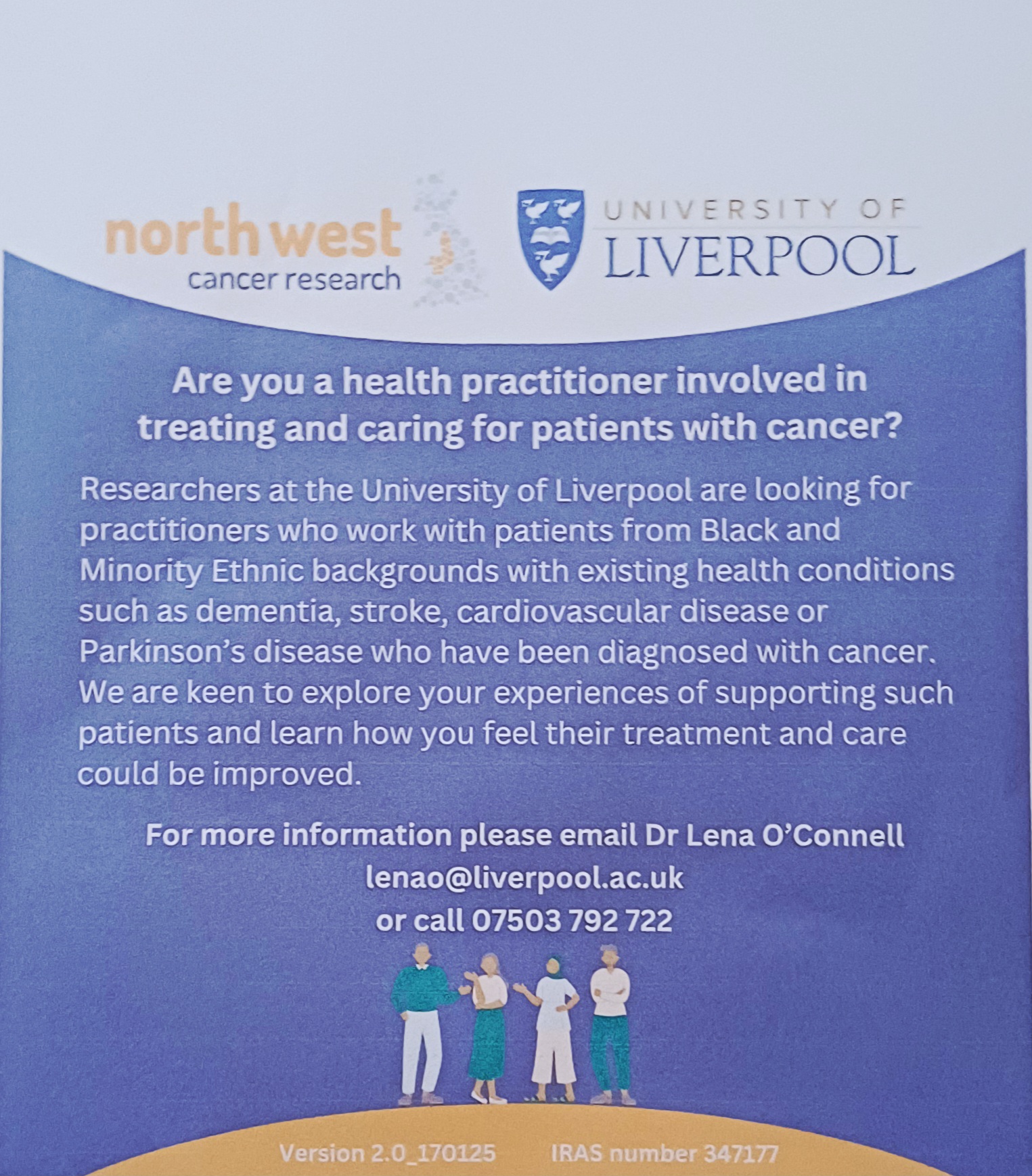
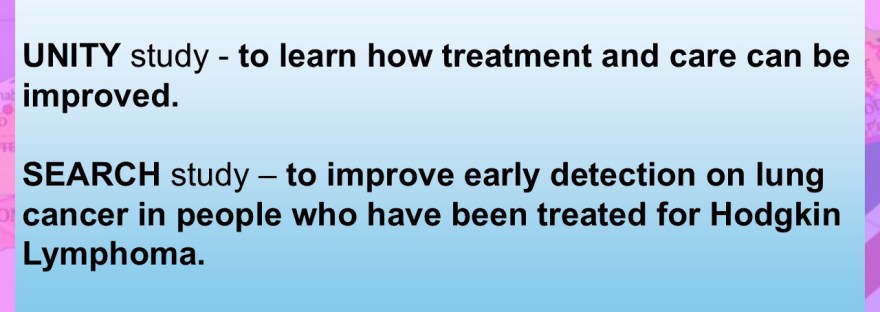
The UNITY study – which is recruiting healthcare practitioners who work with people who have cancer and another serious illnesses(s) to learn how treatment and care can be improved.
The SEARCH study – which is looking for patients to help design a study which aims to improve early detection on lung cancer in people who have been treated for Hodgkin Lymphoma.
The SPARK study – which is comparing cancer patients recruited by hospitals with those recruited by patient organisations. The aim of this project is to guide future research and guideline development to improve the quality and efficiency of recruitment strategies.
This blog was produced on behalf of the British Asian Cancer Charity Research Focus Group. This group is open to everyone, clinicians, patients, relatives, carers.
The group’s objectives are:
Promoting Research Initiatives: Actively supporting and following up on research that directly benefits British Asians affected by cancer.
Identifying Gaps and Opportunities: Pinpointing areas where current data is insufficient and highlighting new avenues for impactful research.
Driving Measurable Improvement: Advocating for and implementing evidence-based changes in cancer care.
Author: Steve Turner – Chair of the British Asian Cancer Charity. Charity Commission Reg. no 1212093 – Data Protection Reg no: ZC044416 For more information contact: steve@cancerequity.org.uk
British Asian Cancer Charity www.cancerequity.org.uk Research Focus Group Newsletter:1 Version:1 29.02.2026
More than three decades after the preventable death of 10-year-old Robbie Powell and the subsequent cover-up by medical professionals, the UK still does not have a legal mechanism to hold individual clinicians accountable for dishonesty. The proposed Hillsborough Law1 – which seeks to establish an individual legal duty of candour on public officials – must include all health and care professionals: managers, leaders, and frontline clinicians alike. Anything less would be an affront to patient safety and public trust.
The heartbreaking story of Robbie Powell, who died in 1990 due to multiple clinical failings, has long been a call to action for legal reform2. His case, meticulously documented and campaigned for by his family, exposed how doctors could mislead families and official inquiries without legal consequence3. The European Court of Human Rights ruling on Robbie’s case made it chillingly clear: there is no individual legal duty of candour on doctors4. The media aptly dubbed it “a doctor’s right to lie.”5 This remains true today.
A conspiracy of silence?
Robbie’s death occurred a year and two days after the Hillsborough tragedy. It is the landmark case on a legal duty of candour. The issue was first raised by the Powells in the UK Courts from 1996 onwards, and then submitted to the European Court of Human Rights in 2000. This pre-dated the call for a legal duty of candour by the Hillsborough families. Yet the call for a Robbie’s Law receives little attention in the press and media. It was referred to by Sir Robert Francis in the report on the failings at Mid Staffordshire6, and the significance of the Robbie Powell case was a factor in the collapse of the 2021 trials of former police officers and a solicitor involved in the Hillsborough disaster7.
After Hillsborough the Robbie Powell case, through its influence on the concept of ‘duty of candour’, played a role in the broader discussions around transparency and accountability in public life. Because there was (and still is) no individual statutory duty of candour on police officers or public officials, the legal framework made it easier to defend against allegations of dishonesty or misconduct, even when unethical behaviour was clear.
That such a crucial legal precedent draws so little public attention is telling. It highlights how deeply entrenched the culture of denial and protection is, not only in policing but across public institutions — including the NHS and the whole of health and social care.
The argument against legally enforced accountability
Some clinicians argue that a statutory duty is unnecessary. In fact, in 1998 a British Medical Association spokesperson publicly defended this view, claiming that ‘the ethics of this are rather more important than the law’ and a strict legal framework would be ‘unhelpful’8. Sadly, history proves otherwise.
In a parallel situation on public accountability, the Post office scandal9, where countless subpostmasters were failed by Post Office leaders and managers who stayed silent, showed the cost of misplaced institutional loyalty. Healthcare has its own shameful examples, including the Infected Blood Scandal10, the widespread mistreatment of people with autism and learning disabilities, and shocking failures highlighted in multiple reports and other systemic scandals examined in the Thirwall11 and Lampard12 inquiries. Again and again, professionals have failed to speak out — and when they do, they are often ignored and even blacklisted12.
This is not a question of bad apples; it is a systemic failure of accountability. Without a legal duty of candour that applies to individuals, there is no deterrent to dishonesty and no justice for those harmed by it. Regulatory bodies have repeatedly proven they are not enough.
Time to act – Hillsborough Law incorporating Robbie’s Law now!
A Hillsborough Law that excludes clinicians from individual accountability would betray the very purpose of the legislation. It would ignore the hard lessons from decades of cover-ups, including the tireless efforts of Robbie Powell’s family to expose the truth. We cannot afford to continue a system where telling the truth is optional, and silence carries no consequence.
Patient safety depends on truthfulness. And truthfulness must be enforceable — not merely expected.
Lampard Inquiry (2025) The Lampard Inquiry is an independent statutory inquiry investigating the deaths of mental health inpatients in Essex between 2000 and 2023 www: https://lampardinquiry.org.uk/ (accessed 28.07.2025)
The systemic silent killer – ending the stigma around whistleblowing.
Summary: In this blog Steve Turner reflects on why genuine patient safety whistleblowers are so frequently ignored side-lined or victimised. Why staff don’t speak out, why measures to change this have not worked and, in some cases, have exacerbated the problems. Concluding with optimism that new legislation going through Parliament offers a way forward from which everyone will benefit.
The scale of the problem: The hidden costs of stigmatisation of healthcare whistleblowers are immense. System wide problems in this area of healthcare are reinforced by a lack of transparency, and the failure of accountability. The consequences of this failure have been investigated many times over the years. A seminal case was that of the Bristol heart surgery scandal in the 1990s. This was brought to light by the anaesthetist Steve Bolsin and led to the implementation of a system of clinical governance (1). This advance in measures to deliver quality, consistent and safe care remains as relevant today as it ever was. More recently the investigation into the failings at mid Staffordshire (2) highlighted how a ‘good news’ only culture, where reputation management was placed above patient safety, is failing patients. Critically for me the shocking fact is that where staff who blow the whistle can’t, or don’t, speak out, are ignored or silenced, the onus to expose wrongdoing falls on patients and their relatives. This involves great personal cost.
This shameful thread of patient-led whistleblowing goes back a long way and has not stopped. Examples where patients, carers, or relatives have had to take the lead and blow the whistle include the death of Robbie Powell (3), Elizabeth Dixon (4), Oliver McGowan (5), Claire Roberts and those who died in the Belfast Hyponatraemia scandal (6), the Gosport War Memorial Hospital scandal (7), and the investigation into maternity services in East Kent (8). These patient safety scandals show no sign of abating despite the report on the failings at mid Staffordshire (2) and Sir Robert Francis’ major review into whistleblowing in the NHS (9). This is reinforced by the 2023 Bewick Review (10) which is the first of a three planned reviews into University Hospitals Birmingham NHS Foundation Trust. This review was commissioned following repeated serious concerns relating to patient safety, leadership, culture and governance, which were initially downplayed or ignored. The full story behind these failings, and their significance, has yet to fully come to light.
Patients have to blow the whistle on unsafe care. A stream of healthcare scandals, (too many to mention all of them here), have been exposed by members of the public. Key examples include the case of Robbie Powell who died of untreated Addison’s disease in 1990 (3). Thanks to the tenacity of Robbie’s father (Will Powell) this led to the clarification of the absence of an individual legal duty of candour for health care professionals (11). Despite numerous reports and failed investigations, including one of which put forward 35 suggested criminal charges, the Robbie Powell case remains open with the Crown Prosecution Service [CPS]. In addition, the former Welsh Ombudsman and the English Ombudsman are both calling for a public inquiry into the case (12).
Another case concerns those who died at Gosport War Memorial Hospital in the 1990s who were prescribed opioid medicines that were not indicated for their condition. This led to an Independent Review Panel (7) which took four years and cost £14 million. The Panel found that 456 deaths in the 1990s had “followed inappropriate administration of opioid drugs”. In 2019 Assistant Chief Constable Nick Downing, head of the Serious Crime Directorate for Kent and Essex Police, announced that a new criminal investigation into the deaths was to take place, and the campaign for justice continues.
Other serious issues include premature deaths of people with learning disabilities and autism (13) which led to the implementation of the learning from deaths programme. On average, the life expectancy of women with a learning disability is 18 years shorter than for women in the general population. The life expectancy of men with a learning disability is 14 years shorter than for men in the general population (14). There are numerous individual cases that support this finding, many of which were first highlighted by parents, informal carers, or relatives. In 2014 the Department of Health and Social Care has published a report which found that almost two-fifths of people with learning disabilities died from causes ‘amenable to good quality healthcare’ (15).
In 2022 a report by Dr Bill Kirkup OBE, into deaths in East Kent NHS maternity services (8) confirmed that the ‘onus was on patients to raise concerns’ because the culture of fear prevented whistleblowers from speaking out. “In every case staff were aware of serious mistakes or wrongdoing but they were unaware of how to raise concerns because those who tried were subjected to peer pressure to be silent and everyone was afraid of the [personal] consequences.” These consequences were exemplified by the experience of the nursing director who was told that speaking up would harm her career. Another significant report is that into the life and death of Elizabeth Dixon (4), which contains recommendations that apply across the board: …’
“(6). Clinical error, openly disclosed, investigated and learned from, must not be subject to blame. Conversely, there should be zero tolerance of cover up, deception and fabrication in any health care setting, not least in the aftermath of error. (NHSE, GMC, NMC, MoJ) ‘
(7). There should be a clear mechanism to hold individuals to account for giving false information or concealing information relating to public services, and for failing to assist investigations. The Public Authority (Accountability) Bill drawn up in the aftermath of the Hillsborough Independent Panel and Inquests sets out a commendable framework to put this in legislation… It should be re-examined. (MoJ)
(8). The existing haphazard system of generating clinical expert witnesses is not fit for purpose. It should be reviewed, taking onto account the clear need for transparent, formalised systems and clinical governance. (DHSC, MoJ)…”
The amount of evidence and the number of reports that were initiated thanks to the tenacity and courage of patients, relatives, carers and parents, is truly shocking. How can we change this? How many more reports do we need? The only thing we can say with confidence is that lessons have not been learned.
Why don’t staff speak out? I was recently asked ‘why don’t staff speak out?’ There’s very little rigorous research on whistleblowing in health and social care, So I can only offer my personal views on this apparent absence of ethical behaviour. I believe this quote from Margaret Heffernan (Professor of Practice at the University of Bath School of Management) goes some way to explaining this:
“I have never encountered an organisation as vicious in its treatment of whistleblowers as the NHS” (16)
If anyone has any doubts there are a string of high-profile cases to support it, including the cases of Steve Bolsin, Raj Mattu, Kim Holt, Peter Duffy and Chris Day.
When I was asked why staff stay silent my first thought was to say that those who would speak out have all left. Of course, this can’t be the full story. So, what are the other reasons? One possible reason is that people who are promoted to highly paid jobs attain these positions because they ‘toe the line’. Organisational psychologists talk about the role of enablers and ‘flying monkeys’ in maintaining this culture. A flying monkey is a psychology term that refers to an enabler of a narcissistic person, a henchman so to speak. Many staff keep their heads down and don’t look too hard at what’s going on around them. Some commentators see this as a behaviour that is supported by the promotion of toxic positivity. What I mean by this is a culture of talking-up successes, however small, completely ignoring failure, and therefore missing the learning that comes from failure. The widely used phrase ‘rock the boat but stay in it’ (17) springs to mind here, especially the empty references to ‘radicals’ and ‘change agents’. This forms part of learning materials which are often accompanied by reams of management jargon and pseudo-science. This leads to a morally bankrupt approach where ‘all is well’ (‘nothing to see here’) and toxic positivity prevails. The belief that no matter how bad a situation is, people should maintain a positive mindset, move on and not mention it, is a way of working that is directly contradicted in these wise words by the late Professor
Aidan Halligan: “Run toward problems, especially on a bad day“
My views may sound very harsh, especially coming from someone like me who left direct employment with the NHS in 2008. It’s important to point out I believe the vast majority of NHS staff, at all levels from clerical staff and porters to senior managers and chief executives, do their best to work around the bullying and toxicity to deliver safe care for patients. Doing their best despite the prevailing culture rather than being supported by it. Sometimes biding their time and subtly subverting directives that are not in patients’ best interests. For clinicians, the threat of being referred inappropriately to a professional body is ever present (18), and an environment where the pressure of work is extreme, exhausting and unstainable are also major factors.
For many, the prevailing culture also means that the careers of highly skilled accountable, ethical and caring staff are held back through denial of learning opportunities and promotion, and informal blacklisting which is commonplace. There’s an army of people ready for change, a huge informal network of highly motivated caring people, which is why I’m optimistic about the future.
Why have ‘speaking up’ reforms failed? These are my personal views based on my experience and that of my colleagues. Since Sir Robert Francis’ whistleblowing report (9) there have been several changes designed to improve the situation. These include Freedom to Speak up Guardians, the introduction of an institutional duty of candour, the ‘Fit and Proper Persons Test’(19) for Board members, and the NHS Whistleblower Support Scheme. In addition, the Health and Safety Investigation Branch [HSIB] was set up in 2017, and a National Patient Safety Commissioner was appointed in 2022.
Given all the above, why has there not been a reduction in high-profile healthcare failings? In my view there are several reasons. Many believe, as I do, that the approach of the Care Quality Commission [CQC] to whistleblowing is part of the problem. We often learn from investigation reports that the CQC (and other regulators) had been listing problems in their reports for years and yet no meaningful action has been taken. ‘Regulatory capture’ is a serious problem, that is when regulators are adversely influenced by the people they are inspecting. This is often linked to the revolving door of staff who move from health and care employment to the regulators, and informal links which amount to cronyism. This behaviour is something that commentators have noted and which I have experienced myself (20). Patients suffer as a result.
The introduction of the National Guardian Office and Freedom to Speak Up Guardians [FTSU] in each NHS trust is also problematic. This initiative has an inbuilt conflict of interest, as the Guardians are employed by the trusts themselves. The All-Party Parliamentary Group on Whistleblowing [APPG] have heard from whistleblowers who have been failed by local Guardians sharing their experiences that included the disclosure of their identity to hospital management and boards, which resulted in retaliation. The APPG has also heard from Local Guardians who were not supported and themselves the target of retaliation after supporting whistleblowers (21). In addition, something which I find shocking is that the National Guardian Office appears to studiously avoid the word ‘whistleblowing’ in its material and outputs wherever possible. This adds to the stigma around healthcare whistleblowers and is inexcusable.
Another lesser known initiative is the NHS Speaking Up Support Scheme (22) (originally titled the Whistelblower Support Scheme). There is not much information available on this scheme in the public domain. I became aware of the scheme when I was asked if I wanted to apply. Later I signposted several people to the scheme. I learned that although the scheme has benefited some people, for others it appears to have made their situation worse. Through a freedom of information request, and thanks to the intervention of my MP, I have managed to obtain a redacted copy of the evaluation of the pilot scheme which supports the view of mixed results (23). Having read this report, it is unclear to me why it hasn’t been published and why it was redacted. Particularly as I think (I can’t be sure of course) that one of the redactions is a comment I made. A comment I wanted to be shared.
As for the other post-Francis review initiatives, the Kark Review in 2018 on the Fit and Proper Person Test [FPPT] is unequivocal in its findings: ‘Essentially it [FPPT] does not ensure directors are fit and proper for the post they hold, and it does not stop the unfit or misbehaved from moving around the system.’(24) In addition, the statutory current duty of candour (25) seems, at times, to be little more than a tick box, with the responsibility for talking to patients often left to the most junior staff. A duty of candour is about simply telling the truth and is everyone’s responsibility, not a task to be delegated. The need for a legal duty of candour on individuals has been highlighted by Robbie Powell’s father Will Powell and links to proposals for a Hillsborough Law.
The HSIB and the National Patient Safety Commissioner initiatives have some built-in limitations to what can be achieved. The HSIB’s remit does not include investigation of systemic problems. This limits the areas that they can cover. As for the National Patient Safety Commissioner, this is a new role which is very promising. Unfortunately, the scope of this role is limited, with the remit covering only medicines and medical devices. This means that these two initiatives are not able to tackle the systemic organisational cultural issues that are at the root of major patient safety failings. One thing that stands out here is that none of the above measures specifically tackle the stigma around whistleblowing in healthcare. In fact, some reinforce the stigma.
A way forward: Much has been written about healthcare whistleblowing and measures that have been implemented to promote positive change. Despite these, the victimisation of healthcare whistleblowers and the stigmatisation around whistleblowing in health and in social care has not abated. The measures introduced have so far achieved very little. In some instances, I believe, they have made the problem worse.
The Protection for Whistleblowing Bill [HL]26 which passed its second reading in December 2022, proposes the repeal of the current Public Interest Disclosure Act27 [PIDA], replacing it with an Office of the Whistleblower [OWB]. This would prevent concerns of genuine healthcare whistleblowers becoming buried under an employment issue, and their original patient safety concerns being side-lined.
PIDA is expensive, limited in scope and beyond the reach of most whistleblowers. It is also overly complex, with cases currently waiting for over 2 years to be heard. Employers game the system to run whistleblowers out of funds. Fewer than 12% of cases that go to the Employment Tribunal win.
PIDA does not protect patients and is not accessible to members of the public who blow the whistle. Currently there is no statutory provision to investigate or address the wrongdoing highlighted by whistleblowers. Many whistleblowers have been denied any protection because they are not workers.
An Office of the Whistleblower would change this and help us identify the root causes of systemic patient safety failings (26). I urge everyone with an interest in this subject to read the bill, and watch the video of Baroness Kramer introducing the second reading of the Bill (28).
NHS England (2023) About LeDeR LeDeR is a service improvement programme for people with a learning disability and autistic people. WWW: https://leder.nhs.uk/about
Steve Turner Steve is a registered general & mental health nurse prescriber (now retired) with a background including clinical education & governance, social policy, and information technology. He is a WhistleblowersUK Health spokesperson, and co-convenor of the WBUK Healthcare Whistleblowing Focus Group Steve’s digital profile: https://linktr.ee/stevemedgov
Acknowledgement: This piece represents the personal views of the author. Thanks to the team at WhistleblowersUK members of the WBUK Healthcare Whistleblowing Quality & Safety Focus Group and all the clinicians who commented on the drafts and posts of this piece. Including Dr David Church GP Locum in Mid Wales – member of Justice for Doctors [J4D] and of MPU (Doctors in Unite, the Union) who peer reviewed the first draft.
Although I’m not an academic and haven’t studied bullying in depth, I’ve experienced it and I’ve also been in situations where, I now recognise, I took a bullying approach. This has led me to consider the difference between accountability and bullying:
Accountability The key thing for me is the difference between holding people to account (e.g., by openly discussing problematic beliefs and behaviours) and bullying.
Accountable actions are driven by the intention / motivation of helping all involved and building an interconnected community based on honesty and trust. (‘Tough love’ if you like).
‘Secret squirrels’ Contrast this to the scenario where bullies criticise people without being specific about what’s being questioned, act secretly and withhold information, blacklist people, create over complex rules which can’t be followed and hide behind bureaucracy and hierarchy.
Specific bullying behaviours include undermining, whispering campaigns, behind closed doors conversations etc.
Look out for cultures where the modus operandı is ‘kiss up – kick down’. If this is the case, the organisation has problems. It will not be able to deliver its aims effectively and may be creating an unsafe environment.
In my experience, around the time of my protected disclosure, I was involved in meetings and discussions where those who had set up the meeting had not stated the purpose of the meeting in advance (or on one occasion deliberately misled me). In these meetings they had clearly rehearsed their questions. Questions that were designed to belittle and discredit.
Sounds familiar?
In these cases, this seems to be motivated by a desire to cling on to power, deny failings, use ‘playground’ tactics and break connections which aren’t in line with the overall agenda (often not made public).
These behaviours are frequently the result of bullying from higher up the chain, and a culture where leaders are not comfortable with ambiguity. Bullying in this context is not always recognised as such, and victims are made to feel it may be their fault. This compromises patient safety.
Bullying is a problem which affects all areas of work, and all sectors. I remain optimistic that, because of the profile this issue now has, things are changing. There’s a long way to go yet, and many injustices to be rectified.
‘People deal far better with uncertainty and stress when they know what’s going on, even if the information is incomplete and only temporarily correct. Freely circulating information helps create trust, and it turns us into rapid and more effective learners’
Margaret J Wheatley (2007) ‘Finding our Way. Leadership For an Uncertain Time’. Berrett-Kohler Publishers Inc. San Francisco
Background: From 2008 to 2014 my company ran education sessions on managing medicines in a mental health trust. In common with some other mental health trusts the provider also looked after paediatric community services. This is not a mental health service. It covers children with complex health needs including enteral feeding tubes, ventilation, epilepsy and rapidly changing medicines.
Children under the care of this service may be taking in excess of 15 different medicines per day, have complex titration regimes, emergency drugs with associated care plans, plus numerous ‘as required’ (prn) medicines.
It is not unusual for children with complex conditions to be under the care of up to five different providers, and to move between three different providers in one day. For example, from a Home Care Service to the Special School, to a Short Break House, also being seen in an Outpatient Clinic on the same day too. As a result, parents frequently have to repeat the information on their child’s medicines every time they move to another service, or a new person is involved.
Where to start? The idea for change came about because of concerns that the staff in Children’s Short Break Houses were not learning what they needed about children’s medicines, as the learning was geared to the majority of staff who worked in mental health. So a new learning package for children’s staff was commissioned.
Part of the work to design the learning package included a baseline assessment which was conducted with parents and staff. This soon revealed that training alone was not the answer. It showed delays in medicines information reaching GPs, workarounds for obtaining information in order to administer medicines in the houses and a general lack of confidence in the whole process.
As a result, we looked at the whole system starting with the area where most concerns had been raised, which was having an up-to-date complete list of a child’s medicines available at all times (medicines reconciliation). The system in place for Short Break Houses involved paying a local GP (not usually from the child’s GP Practice) to write up a medicines chart for each child. The process was fraught with difficulties and delays and widely disliked by everyone directly involved.
So we set about looking for a new way to manage the lists of medicines with more training and more input for the staff in the services involved. We came up with a new (and much more robust) process for medicines reconciliation in the Short Break Houses. This was fully documented in a new policy and involved cross-checking by both the staff and the parents.
Just before this went live, we asked the parents to review and comment on it and they said: ‘If you’re producing an accurate and up-to-date list of my child’s medicines, why keep it the Short Break House, can’t it go with my child?’ So, the My Medicines chart, which travels with the child, was born.
What was involved? The My Medicines process led to the design and production of a new chart which has to be signed and checked by the parents. It resulted in 40 children with complex conditions being offered a hand held paper record of their medicines (produced and validated by clinicians), which they take around with them wherever they go.
Benefits: The new process, which continues to evolve, means that the child’s GP is now directly involved in day-to-day medicines reconciliation (they weren’t before); the parents are always asked to check and sign the charts (they weren’t before); verbal messages about medicines are never taken, and incomplete (or missing) directions are rapidly rectified (never worked around).
Some specific benefits of the new process included: • It reduced the risks of error, by providing full and accurate information on children’s medicine across their entire pathway. • It cut out the need for parents to keep having to repeat what medicines their child is taking to different professionals and care agencies. • It freed up medical and clinical time which was previously spent chasing missing information. • It reduced the number of third-party handovers and transcribing of prescription information.
Looking back, it’s hard to believe that the old ways of working, which caused so many difficulties (especially for front line staff), were carried out for so long. These risky practices, or similar, are believed to still be commonplace in England.
Revealing hidden incidents and near misses:
In the first month of the project we raised 17 medicines incidents or near misses. Of these 11 related to problems with communication of information across the child’s pathway.
Resolving these has resulted in improved communication and engagement between different clinical groups and providers, and a desire from all quarters to take the project further. Previously many of these incidents were not logged or tracked across organisations. In some cases, it was only due to the vigilance of the staff and parents that they were spotted, and errors avoided.
Accepting the changes:
The project was well received by parents and staff and resulted in improved communication and engagement between different clinical groups and providers. This included the Consultant Paediatricians (working for the secondary care provider), who were initially sceptical.
The project was less well received by the relevant medicines and prescribing committees, who were understandably concerned about who owned the My Medicines chart and had agreed to its content. Explaining this was made more difficult because it is hard to get across the complexity of the arrangements, due to the critical nature of the children’s illnesses, in a committee setting.
I make no apologies for ensuring from the outset that it was the parents who owned the charts, which were designed by the project team (not a committee) to meet all best practice standards. It always worries me that when it comes to cross- organisational working the formal committees and systems in place can inadvertently act as a barrier to safety rather than promoting it. There is no doubt we had designed a safer process and my company was happy to take accountability for any associated risks.
As a legacy of the project, a Community Paediatric Pharmacist was appointed specifically to work with this group of children. So whatever evolves will now be based on inter-disciplinary thinking and working and will have clear safety parameters. I am grateful for the enlightened thinking of the leaders who commissioned this work and supported this novel approach.
Steve Turner RGN, RMN, Ba (Hons), P.G. Dip. Ed.
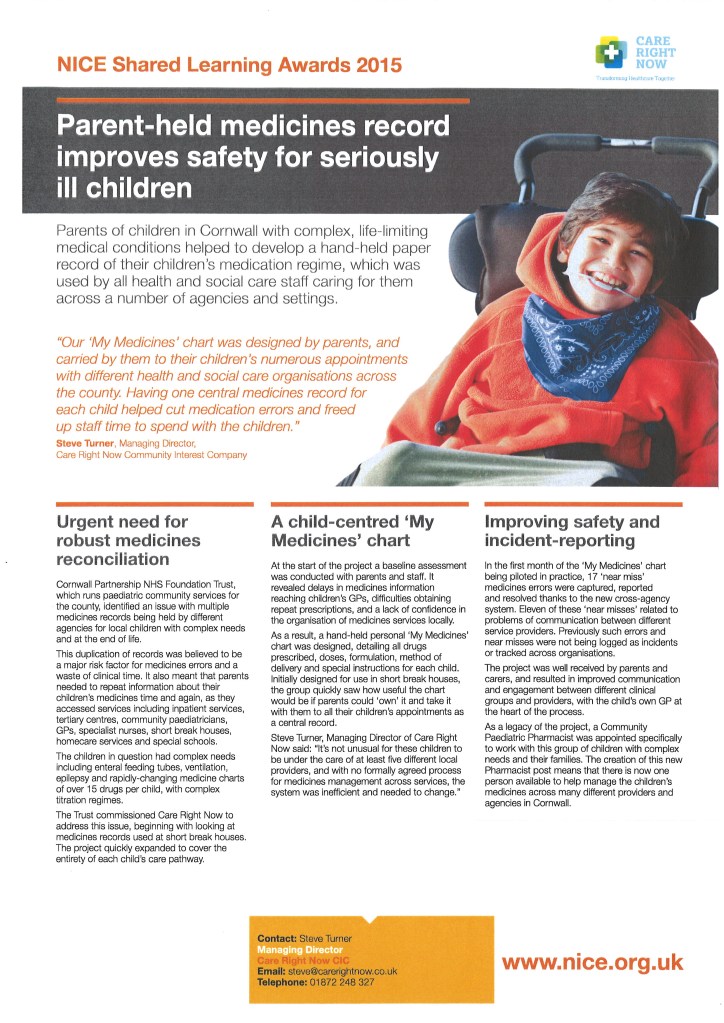
This example was included as a NICE Shared Learning resource and was highly commended by NICE in 2015.









 Steve Turner's blog site