

Introduction
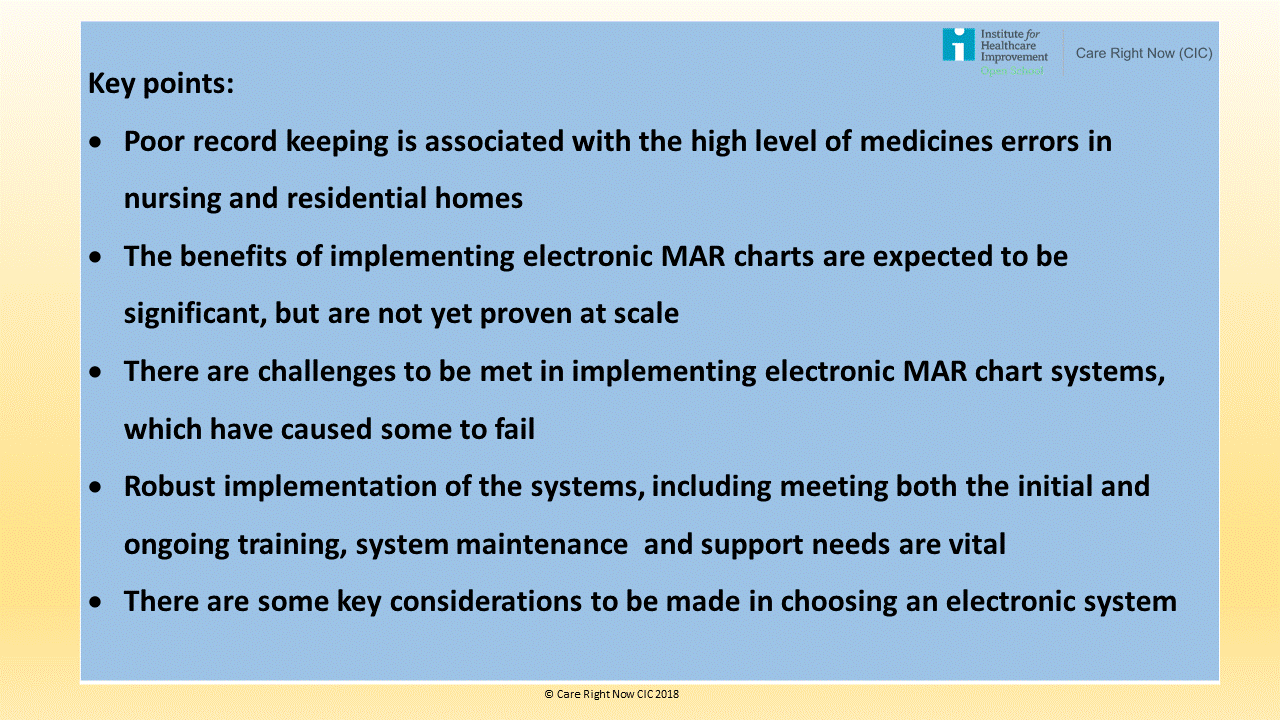
Medicines errors in care homes are unacceptably high. A key study found that residents taking seven or more medicines had a 79% chance of being victim of a medicines error (Alldred et all 2009). This led to several follow-up studies and actions to improve medicines management in care homes, including a move to implement electronic medicines administration [eMAR] systems. A recent study explored medication-related incidents and their causes in UK care homes. This review emphasised the need for improved medication management processes to reduce errors and enhance patient safety (Irons et al 2022).
Best practice in medicines record keeping
The management of medicines in nursing and residential homes is part of a highly complex pathway. It involves multiple staff groups and organisations.
These include the G.P.; all who prescribe medicines and treatments; Care Staff of all grades; Support Workers; Consultants; Specialist Practitioners; and Pharmacists.
Benefits of electronic MAR charts
The benefits of implementing electronic MAR charts fall into three categories.
- Improved legibility.
- Improved access (e.g., if the charts are accessed and updated on a computer or portable device there is less risk of losing, damaging, or mislaying them).
- eMAR chart systems that obtain the data taken directly from the Community Pharmacy system eliminate the need for transcribing.
Systematic reviews indicate that carefully planned and implemented eMAR systems contribute to a decrease in medicines errors, reduced administrative costs and improved quality of care (Gates et al 2021).
Challenges of implementing electronic MAR charts
There are three ‘bottom line’ challenges to manage when transitioning to electronic MAR charts.
1. Assessing potential eMAR systems. This is critical, as poorly designed systems will not deliver benefits, and eventually fail. The system must be easy to use and free of unnecessary jargon, using only approved acronyms or mnemonics. Electronic systems also offer the opportunity to introduce features which enhance safety, some of which, such as time ordered charts, are difficult to include in a paper-based syste
Here’s a some key features to look for:
- Photo identification
- Time ordered charts
- Body maps
- Drug images
- Start and finish dates
- Insulin charts
- Warfarin charts
- As required – prn- charts
- Does the system record the reason prn medicines were given?
- Medication history
- Medication profiles
- How the system records allergies and sensitivities
- What alerts and warning messages are included?
- How the system copes with medicines dispensed directly from hospitals
- How does the system cater with titration of medicines and variable doses
- How does the system cater with weekly medicines (e.g. alendronic acid)?
- Use of monitoring information (e.g. INR for warfarin administration, lithium level recording, BMI, B/P, pulse etc.)
- That the system uses up to date approved terminology
- Does the system records medicines not given or partially administered, with a reason?
- How the system can be used to order and control stocks of medicines
- How easy is it to produce reports from the system?
2. Data Security and Protection. It is vital that the system handles patient consent; patient confidentiality, system access; ownership of patient identifiable data; storage and transfer of data in a way which is compliant with the laws and regulations of your part of the U.K.
All organisations and systems that access to NHS patient data must successfully complete the NHS data security and protection toolkit [DSPT]. This toolkit provides assurance that the system suppliers are handling data safely and that personal information is handled correctly. You can search the supplier’s NHS DSPT registration here: https://www.dsptoolkit.nhs.uk/OrganisationSearch
3. Process Reviews. It is important to look at your current processes and how the new system will work. For example, there have been problems where urgent acute prescriptions were supplied by a different pharmacy from the pharmacy linked to the home’s eMAR system. The eMAR system must be able to cope with all aspects of prescribing from multiple sources and prevent information having to be duplicated.
Training and support requirements
Quality training and support, both during the implementation and on an ongoing basis, underpin all successful healthcare I.T systems. There are four areas which are sometimes overlooked that deserve special mention:
1. Many of the users of eMAR systems will be Healthcare Assistants or other non-registered skilled staff. As a result, it will be important that the training they receive reinforces their duty to keep accurate records, that they know where to go for help and advice and their role and responsibilities are made clear.
2. A substantial number of staff may speak English as a second language. Therefore, it is important that eMAR systems do not use any unnecessary jargon, and that any help text is in plain language.
3. Appropriate knowledge of Data Protection (GDPR) and Information Governance rules and regulations is essential and should be built into any training programmes.
Overall, consideration needs to be given to the nature and content of the training needed to implement the system, including how this is linked to the policies and procedures and overall governance of the home.
Good suppliers will be able to give advice and support on this.
Conclusion
Record keeping in medicines management is a critical safety area for care homes. The current high level of medicines errors is in care homes affects half a million people in England.
The prospect of implementing electronic systems for recording medicines administration holds great potential but is not itself without risk. It needs to be approached carefully in the light of the complex arrangements and multiple organisations involved in prescribing, supplying, administering, dispensing and monitoring medicines for your residents.
Given the considerations over choice and implementation of systems, eMAR can overcome problems of legibility, transcribing, and access to records and information in a way which is not possible with paper systems.
In years to come it is likely that, just as most G.P.’s would not want to return to paper systems, care homes will come to see electronic systems in the same way. The main beneficiary of this will be the residents in terms of improved safety.
References:
- Alldred P, Barber N, Buckle P et al (2009) Care home use of medicines study (CHUMS): Medication errors in nursing and residential care homes – prevalence, consequences, causes and solutions. Report to the Patient Safety Research Portfolio. Department of Health, London.
- Peter J Gates, Rae-Anne Hardie, Magdalena Z Raban, Ling Li, Johanna I Westbrook, How effective are electronic medication systems in reducing medication error rates and associated harm among hospital inpatients? A systematic review and meta-analysis, Journal of the American Medical Informatics Association, Volume 28, Issue 1, January 2021, Pages 167–176, https://doi.org/10.1093/jamia/ocaa230
- Irons, M. W., Auta, A., Portlock, J. C., & Manfrin, A. (2022). Medication errors and processes to reduce them in care homes in the United Kingdom: a scoping review. Home Health Care Services Quarterly, 41(2), 91–123. https://doi.org/10.1080/01621424.2021.2007196
Author: Steve Turner RGN, RMN, Ba (Hons), PG Dip Ed – a retired experienced nurse educator, who has worked in strategic consultancy and on change projects across healthcare in the UK. |
Blog last Updated: 28.02.2026
 Steve Turner's blog site